SECTION 4: WHAT COMES AFTER CUSTOMER DISCOVERY
Once you have clarity about the customer and their problem, you’re ready for the next step: Idea Validation. Idea Validation means offering a small, low-cost representation of your idea – something someone can react to.
This could be:
- A one-page description
- A rough sketch
- A mockup or basic prototype
- A simple landing page describing your offer

Keep Your Ears Open: When you begin the process of Idea Validation you’re looking for actions, not compliments. This could look like:
- Someone offering their email
- Agreeing to try a demo or pilot
- Asking when it will be ready
- Making an introduction
- Expressing willingness to pay
Idea Validation doesn’t need to be heavy. It just needs to give you enough direction to take your next confident step. So how do you go about doing it?
IDEA VALIDATION – FIRST STEPS AND WHY IT MATTERS
By now, you’ve talked to people, asked questions, and started to understand what problems, needs, or desires really exist. You’ve moved beyond guessing and begun seeing patterns and insights that show you where opportunities might lie.
Now it’s time to take the next step: turning what you’ve learned into something tangible. Customer Discovery helps you understand the problem; Idea Validation helps you test your solution.
Whether it’s a product, a service, or a new way of doing something, you now have a hypothesis and a belief that your idea can solve the customer’s problem in a way that’s valuable to them. But a hypothesis is still just that: an educated guess. Idea Validation is the process of testing that guess in the real world.
Importantly, the goal of idea validation isn’t to prove you’re right. It’s to find out how close you are and what needs to change. You’ll use the insights you learned from Customer Discovery to design small, low-cost tests that show whether your solution truly fits what customers want, and whether they’ll actually pay for it.
But there’s more to validation than just customer feedback. You also need to test feasibility: Can your idea actually be done? Are there legal or regulatory barriers? Does your idea require licenses, certifications, or special approvals? Some of these questions might shape or even redirect your path. Great entrepreneurs don’t just test what customers want, they also test what’s possible. In short, Idea Validation is about bringing reality into your idea. It’s where vision meets evidence, and where your potential business starts to take real shape.
What Do You Need to Validate Your Idea?
The most important thing you need to validate an idea is an actual idea. Something tangible that you can show, describe, or test. It doesn’t have to be perfect; it just has to exist in a form others can understand and respond to.
Entrepreneurs call this early version a Minimum Viable Product (MVP): the simplest form of your idea that still delivers value. But even before you reach that stage, you can test smaller steps, like describing your idea to potential customers, showing visuals, or sharing mockups, and from there you can refine it with their feedback.
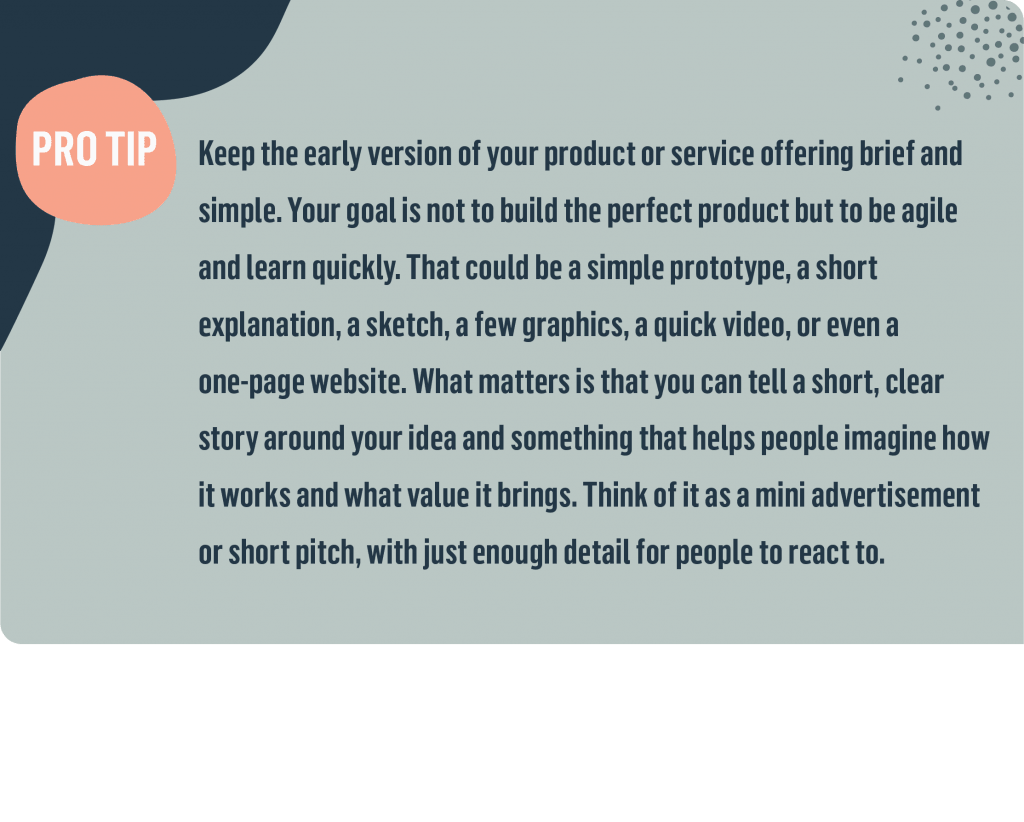
Remember, your first version is not your final one. Many founders discover through testing that their “product” becomes something else entirely like a website, a digital platform, or a service model. That’s a normal part of the journey.
The key is to avoid spending too much time or money on your first idea before getting feedback. Bring your concept back to the people you talked to during Customer Discovery, show them your progress, and listen carefully to their reactions.
Who Do You Validate Your Idea With?
You validate your idea with the same people you believe have the problem: your potential customers. That’s what you began identifying during Customer Discovery. The best place to start is by going back to those same people, or other people that you’ve identified during your customer discovery journey with ideal customer profiles, and testing your idea with them.
If you’re building a business in Northern Michigan, your first customers are probably closer than you think. Validation doesn’t require a global audience, it can start right in your backyard. The people and businesses around you are not just potential customers, they’re also an invaluable source of honest feedback.
Start local. Understanding your region’s demographics, industries, and community dynamics can give you a strong foundation for testing your idea. Northern Michigan has a mix of rural communities, small businesses, healthcare providers, tourism, agriculture, and growing tech and manufacturing sectors; each with its own set of unique needs and challenges.
Talk to people who reflect your ideal customer. Some ideas:
Another often overlooked but valuable source of potential customers can be industry events. Identify conferences or expos within your business idea’s industry vertical and put yourself out there!
- If your idea targets consumers, visit farmers markets, coworking spaces, and community events.
- If your focus is business-to-business (B2B), connect with local organizations, chambers of commerce, and industry associations.
- If you’re building something for specific sectors like healthcare or logistics, reach out to regional companies or service providers.
- Another often overlooked but valuable source of potential customers can be industry events. Identify conferences or expos within your business idea’s industry vertical and put yourself out there!
How Do You Validate Your Idea And Refine It?
Validation happens through conversation. You learn whether your idea resonates by talking to real people. These conversations can be structured or casual. You might send out a survey to gather feedback on what people like, why they like it, how they’d use a product or service, or what alternatives they currently rely on. Or, you might simply sit down over coffee and talk it through.
The setting doesn’t matter- what matters is listening. People will tell you what they think of your idea, often in ways you don’t expect. It’s important to effectively record your date, so be prepared to take good notes, record conversations, and collect feedback systematically. Over time, patterns will start to appear. You’ll notice that certain topics or suggestions will come up again and again, revealing where your idea connects and where it needs work.
And that’s the point: validation is not just about confirming your idea, it’s about refining it. You might pivot and end up with something very different from what you started with, and that’s a sign of progress, not failure!
Every successful business goes through this cycle. For example, the first mobile phones had little in common with the latest smart phones, and each version was built on feedback, iteration, and improvement. Businesses evolve because their customers and markets do too. Iteration of your product is actually a very healthy sign! Iteration on your first version gets you started, your second version helps you grow, and every improvement after that opens up new opportunities.
In short, much like Customer Discovery, validating your idea isn’t a one-time step. Rather, it’s an ongoing dialogue with your customers, and it never really stops.

Idea Validation and the Bridge to Financial Analysis
A strong idea is a powerful starting point. But, what turns that idea into a real business is understanding whether it can support itself financially. A simple financial check early on helps you see the potential of your idea and gives you confidence about what to focus on next.
At the same time, think about what it takes to deliver your product or service. Consider your costs alongside what customers are willing to pay. When those two numbers are in alignment, you are on solid footing and ready to build something sustainable.

Next, zoom out and look at the bigger picture with some simple math. How many potential customers exist? Roughly how many of them might buy? The numbers do not need to be perfect. They simply help you understand scale. For example, if you plan to sell a $100 annual subscription service, you will need a large customer base to generate meaningful income. That clarity helps you make smarter decisions early.
This kind of early-stage financial thinking does not require complex spreadsheets or a formal business plan. You do not need a balance sheet or cash flow statement yet. What you do need is an honest look at three questions:
- How much could you make per sale?
- How many people would realistically buy your product or service?
- What does it cost to deliver?
Together, these numbers form the foundation of your profit and loss and offer a simple way to assess whether your idea can grow into a lasting business.
As you continue validating your idea, keep these financial signals in mind. The strongest businesses solve real problems in ways that also make economic sense. When your solution resonates with customers and supports a healthy bottom line, you are well on your way from idea to sustainable business.

